
Where Lee County Arrest News Is Published
Begin with the Lee County Sheriff's Office press-release archive. It is the strongest ongoing source of local public-safety news. You can search it and narrow results by category, year, and page. Recurring Sheriff's Reports open a week-by-week window on county activity. Single releases sometimes cover one incident in depth. That makes the archive the best place to pin down a date, an agency, or an event worth checking against the official record.
Know its limits, though. It is not a live Lee County Jail roster. It is not a booking index or a photo gallery either. LCSO shut down its online roster in December 2025, citing scams, fraudulent calls, and identity exploitation. A person can be booked at the jail without ever showing up in a same-day roster entry. The archive stays useful, but it cannot confirm current custody or take the place of a records request.
The LCSO press-release archive shows the official interface for finding reports by date, category, and page.
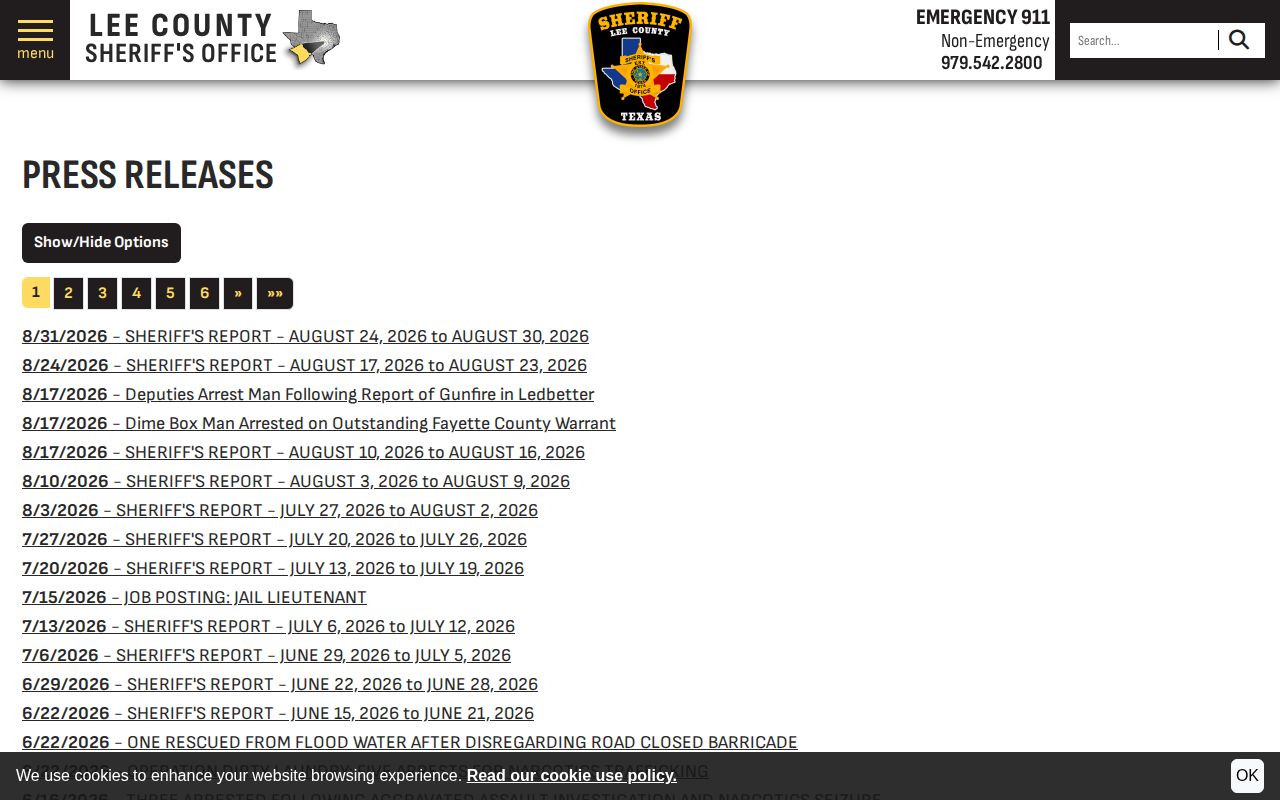
Narrowing a search to one week or one incident helps a lot. Even so, the report you land on is a narrative publication, not a searchable booking database.
Lee County Sheriff’s Reports Cover Seven-Day Narratives
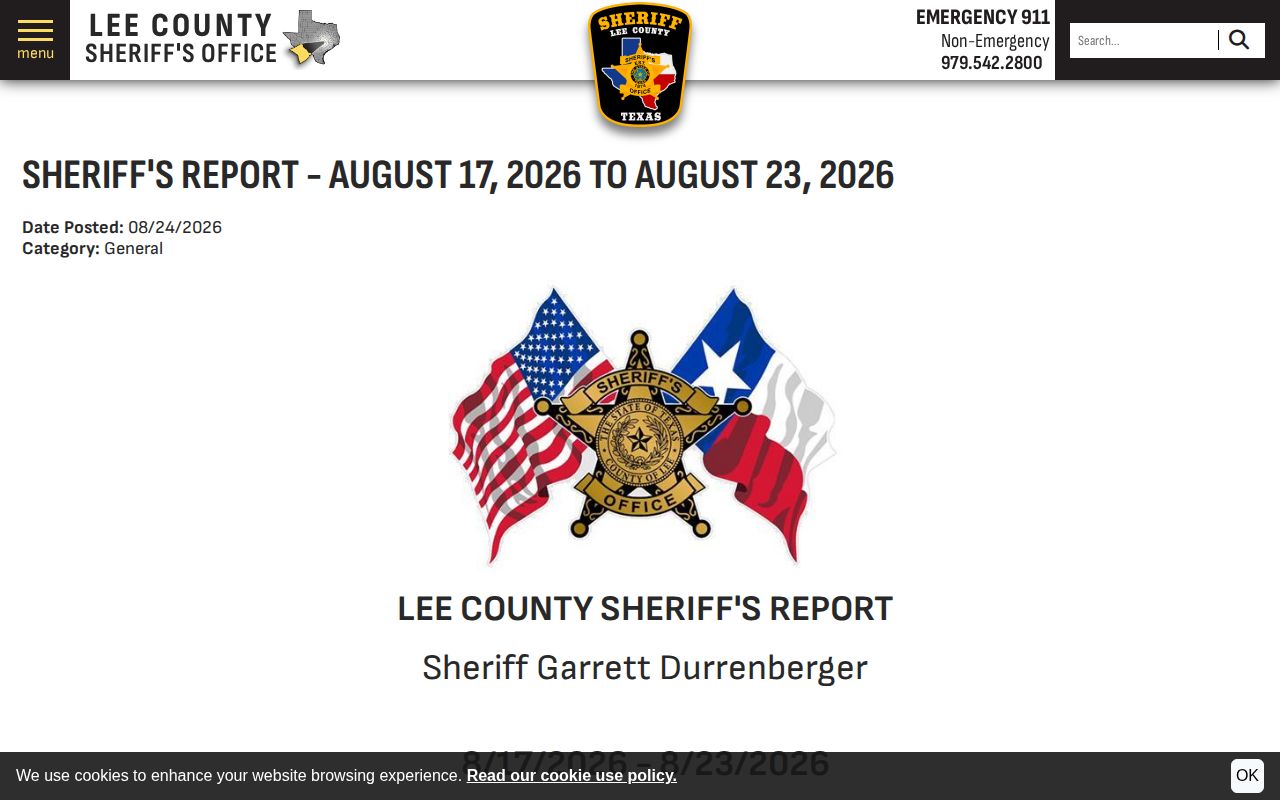
A weekly Sheriff's Report reads nothing like a jail record. Take LCSO's August 17 through August 23, 2026 report. It lays out daily public-safety activity across seven days. One of these reports can name an event date, the agency involved, an offense, warrant details, and a booking into Lee County Jail. Those are the practical facts a reader needs before asking LCSO for a specific record.
Coverage is not complete, though. A report will not account for every arrest, booking, or person in custody. It also says nothing about whether someone is still in the jail. The person may have been released, transferred, or routed into a different court. Treat the weekly report as an official lead with a date range. Then use the public-information route and the court docket to learn where things stand now.
This example Sheriff's Report shows the seven-day narrative format, not a face-filled booking display.
A dated entry makes follow-up easier. If a name in a Lee County sheriff's report catches your eye, you can carry that date straight into a records request or a court search and see where the case went from there.
Lee County News and Record Sources
Official sources come first for a reason. They sit closest to the event and to whoever keeps the record. Historical news adds context. Third-party listings can be incomplete, delayed, borrowed from other sites, or simply stale. No Giddings or Lexington outlet runs a dedicated daily booking-photo page or a live arrest blotter right now. In the table, "Photos" describes what a source offers. It is not a promise that a picture exists for any particular person or event.
| Outlet | Coverage | Photos? | Where |
|---|---|---|---|
| LCSO press releases | Official selected releases and recurring seven-day Sheriff’s Reports for county public-safety activity. | No verified complete booking-photo gallery. | Searchable official archive with categories, years, and pagination. |
| UNT Giddings Area Newspapers | Historical Giddings Times & News, Giddings News, and Lexington Leader issues with OCR. | Individual historical issues may contain images; no current gallery is verified. | Issue-based archive for older reporting. |
| Lexington Leader | Current outlet URL requiring manual verification. | Not verified. | No current crime section, cadence, or photo practice is claimed here. |
| Busted Newspaper | Unofficial county booking cards observed with late-2025 context. | Cards may display photographs where available. | Secondary source only; not a current LCSO roster. |
| RecentlyBooked | Unofficial Lee County landing page with a rolling recent window. | Not a verified official photo source. | Reported no Lee County records in the last 30 days on August 31, 2026, which does not prove no arrests occurred. |
| Mugshots.com | Unofficial historical Lee County index with older dated records. | Some entries may state “No Mugshot Available.” | Not a live county-custody roster. |
| Arrests.org and Mugshots.zone | A Texas statewide Arrests.org page was found, but no Lee-specific URL was verified. No Lee County, Texas Mugshots.zone section was verified. | Not verified for a Lee County local source. | Neither establishes a current local publication channel. |
Jail Exchange is another unofficial directory. It sometimes repeats legacy roster instructions that conflict with LCSO's roster-closure notice, so treat the sheriff's office and the arresting agency as the real verification route.
Historical Giddings and Lexington Crime Reporting
For older crime reporting, the UNT Portal's Giddings Area Newspapers collection is the practical local route. It holds digitized issues of the Giddings Times & News, the Giddings News, and the Lexington Leader. Everything is searchable through OCR. The old pages mention Lexington police reports, sheriff incidents, and Lee County Jail activity. That makes the collection handy for tracking down a dated report or the agency tied to an event.
Its limits matter too. The archive is historical, not a live news feed. An old clipping proves nothing about whether a booking photo is still public or whether anyone remains in custody. For more local context, see the separate Giddings Busted Mugshots record page and the Lexington Busted Mugshots record page. Current confirmation still runs through LCSO, the arresting agency, and the court.
The Lexington Leader's live URL is available for manual checking. Its current sections, publishing frequency, and photo practices are another matter entirely.
How Lee County Booking Images Reach News
Not every Lee County arrest ends with a photo the public can see. The Sheriff's Office publishes weekly narrative reports and selected releases. It runs no booking gallery, and the online inmate roster is not available right now. A news story might draw on an agency release, an event report, an existing public record, or plain reporting with no image attached. A missing photo tells you nothing. There could still have been a booking.
Photos on unofficial sites deserve the same skepticism. Pin down the date, the agency, and the place first. Then ask the record holder directly. Keep the request narrow. The LCSO public-information page lists the official contact route for county-held records. Its request form covers booking details and photographs, subject to review and applicable law.
From Lee County Arrest News to Official Records
Solid follow-up work runs in one direction: from the news account to the custodian's record, then to the court. The countywide Lee County booking and records information goes deeper into the roster closure, jail records, and what happens after custody changes hands. Keep the purpose narrow. A headline is a starting point, never the last word on a case.
- Capture the identifying details. Record the date, source, reporting agency, location, and any stated alleged offense. Those details make an official request more precise.
- Check the official report window. Search the LCSO press-release archive for the relevant week or event. A matching report can confirm that LCSO publicly described an incident, but it cannot confirm present custody.
- Use the official records route. Because the online roster is offline, contact LCSO through its public-information channel or submit the county Open Records Request for an existing booking record or photograph. Ask for a cost estimate if one is needed; the county materials reviewed do not publish a fixed booking-photo fee or response time.
- Confirm the court file. Use the Lee County District Clerk for district criminal docket links and court follow-up. A cause number and docket events place the reported arrest in the court process.
- Follow the disposition. A disposition is the court’s outcome, such as a dismissal, plea, trial result, or other resolution. Court proceedings can change, so confirm with the appropriate court rather than relying on an early story.
Case outcomes live in the court file. For the record that settles the matter, turn to the District Clerk's criminal docket rather than any news account.
Why the Weekly Report Needs Court Follow-Up
The weekly report works best as a bridge. It can give you the date, the originating agency, the alleged offense, warrant context, and a sign that the person was booked into Lee County Jail. The District Clerk's criminal docket resources do a different job: finding the case and tracking what happens after the report runs. Read the two side by side. One is not a substitute for the other.
Custody has limits, too. A weekly report won't tell you who sits in jail today, and a docket is not a roster. When a case later leads to state custody, the official Texas Department of Criminal Justice offender search covers that stage, which sits well beyond a fresh Lee County booking. For a current county-held record, start with LCSO's official request channel.
News coverage earns its keep by pointing back to those primary sources. That keeps the local history of an event intact while the official record and the court do the deciding.